
Natural Stone Tile Installation
Marble, granite, slate, travertine and quartzite installation for embassy reception, banking halls and luxury Accra residences — set to ANSI A108 with deformable ISO 13007 C2 S1 adhesive, impregnating sealers and efflorescence control. Tilers Ghana, since 1976.
Natural stone tile installation is the specialist discipline of setting geological materials — marble, granite, slate, travertine and quartzite — to precise dimensional and structural tolerances. Unlike ceramic or porcelain, each consignment carries its own porosity and veining that must be read technically before a single tile contacts adhesive. Tilers Ghana has set natural stone across Accra since 1976, matching every floor to its stone, its substrate and its exposure.
Why Natural Stone Demands Specialist Setting in Ghana’s Conditions
Natural stone is unforgiving in Ghana’s climate. With average humidity around 81–83%, porous stone such as marble, travertine and limestone is vulnerable to efflorescence — the white salt bloom that surfaces when moisture carries soluble salts up through the bed — and to moisture shadowing that darkens the face. Translucent marble compounds the risk: it telegraphs every void and any grey cement adhesive straight through to the surface as a permanent shadow. A floor set by a general tiler over inconsistent coverage shows these faults publicly, and they cannot be polished out.
The controls are specific and non-negotiable. We set stone in white deformable C2 S1 adhesive at ≥95% coverage so no void or grey cement shadows through, apply penetrating impregnating sealers before and after grouting, and use efflorescence-resistant low-water setting to keep salts from blooming on marble and limestone. The discipline is in reading the stone and matching the bed to it — not in a single product.
Natural Stone We Install in Accra
Marble (Carrara, Calacatta — honed or polished)
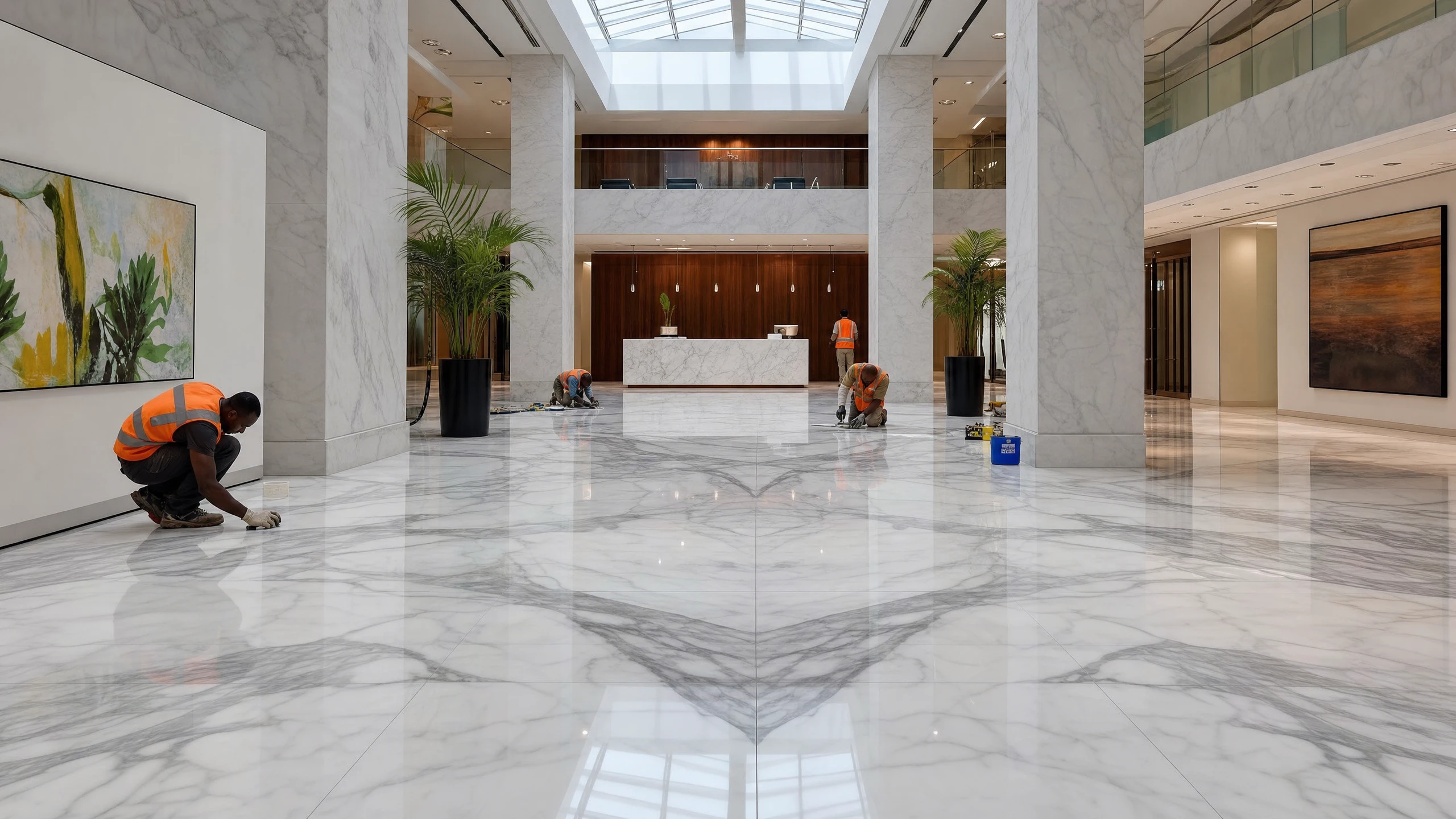
Honed and polished marble — Carrara and Calacatta among them — is the signature of banking halls and ceremonial reception floors. Because it is translucent and porous, it is the most demanding stone to set correctly: it must go down on white deformable adhesive at full coverage and be impregnate-sealed before grouting, or voids, grey shadowing and grout staining will surface within weeks.
Granite (dense, near-zero absorption, high-traffic)
Granite is dense, with near-zero water absorption, and is specified where heavy traffic and chemical resistance matter — corporate concourses, lobby thresholds and high-wear corridors. It seals far more easily than marble and resists staining, but still benefits from a maintenance seal and demands the same flatness and coverage discipline beneath it.
Travertine & Limestone (filled or unfilled, sealed)
Travertine and limestone carry natural voids that are either factory-filled or left unfilled for a rustic finish. Both are porous and must be impregnate-sealed and set with efflorescence-resistant low-water bedding, since they are among the stones most prone to salt bloom in Accra’s humidity.
Slate & Quartzite (riven or cleft textures)
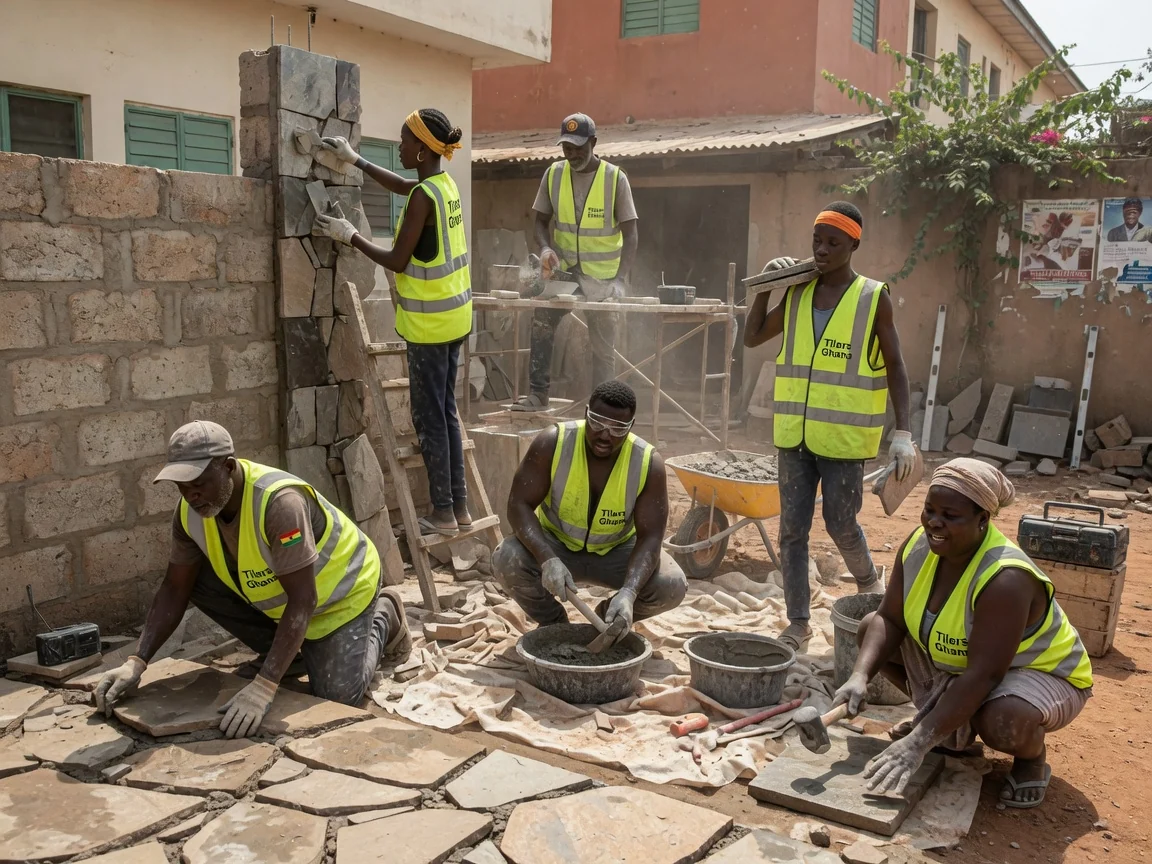
Slate and quartzite bring riven, cleft textures with variable absorption from piece to piece. They are favoured for terraces, entrances and feature floors where grip and character matter, and are set with a sealing regime matched to each consignment’s measured porosity rather than a fixed assumption.
The Natural Stone Setting Doctrine
| Standard | What it governs | Why it decides the floor |
|---|---|---|
| ANSI A108 | The stone setting method itself — flatness tolerance, layout and adhesive coverage | It is the governing installation standard for natural stone; coverage and flatness set here determine whether voids or lippage show |
| ANSI A118 | Mortar and adhesive classification — white deformable adhesive for stone | A non-staining white deformable mortar is required so grey cement does not shadow through translucent stone |
| ISO 13007 | Adhesive performance — C2 improved, S1/S2 deformable | C2 S1 deformability lets the bed absorb thermal and structural movement without debonding dense or large stone |
| EN 14411 | Classifies ceramic and porcelain tile (contrast point) | Natural stone is a geological material and is NOT classified by EN 14411 — for stone the governing setting standard is ANSI A108, not EN 14411 |
| TCNA EJ171 | Movement and expansion joints | Stone floors need correctly placed movement joints to absorb thermal expansion and prevent tenting or cracking |
| Substrate flatness & deflection (L/360) | Structural deck behaviour beneath the stone | Deflection beyond L/360 cracks rigid stone and opens joints; flatness must be confirmed before bedding |
| Impregnating sealer & efflorescence control | Surface protection and salt management | Penetrating sealers and low-water setting prevent staining and the white salt bloom that humidity drives to the surface |
How We Install a Natural Stone Floor
- Stone survey & substrate assessment — we read each consignment’s porosity and veining and assess the substrate per ANSI A108, confirming flatness, deflection within L/360 and acceptable moisture before any stone is ordered to the floor.
- Dry-lay & vein-matching — slabs and tiles are sequenced and vein-matched on the floor, cuts are pre-marked, and any micro-fissured piece is quarantined before it reaches the bed.
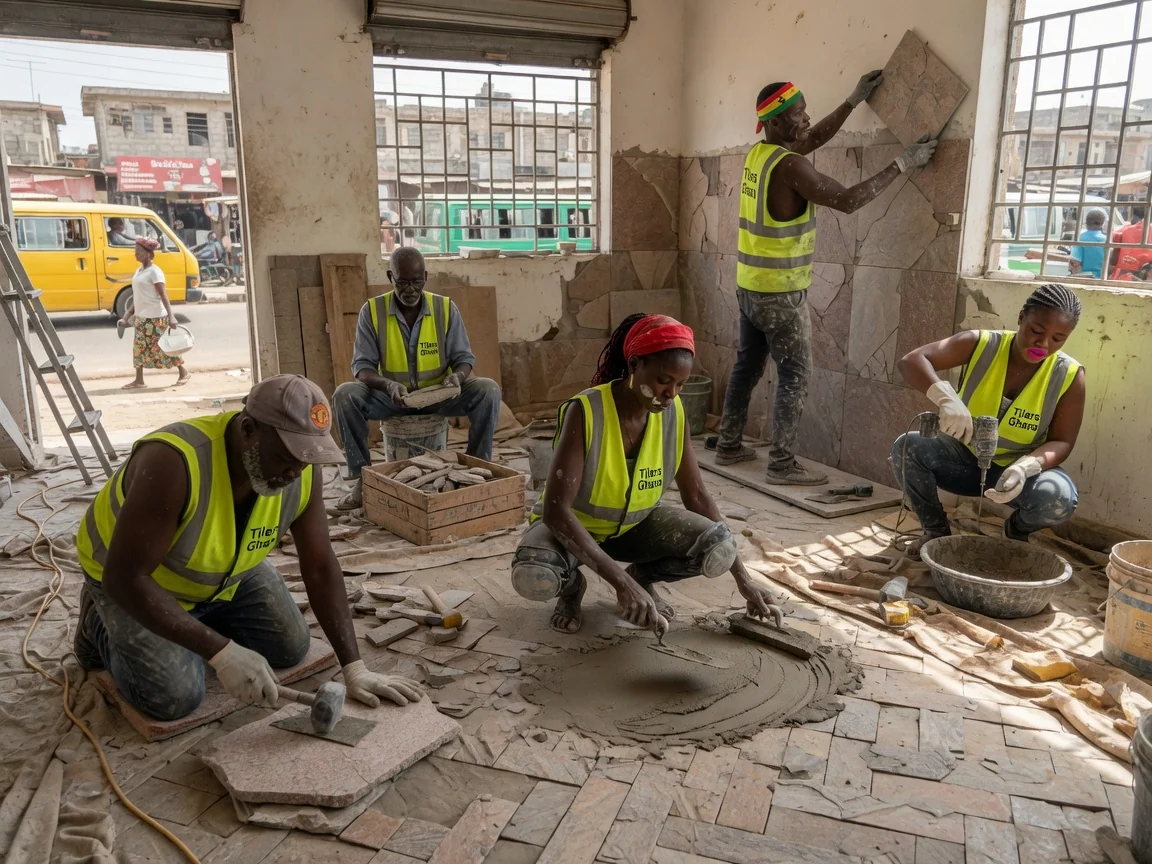
- Bedding with white deformable adhesive — stone is set in ISO 13007 C2 S1 white deformable adhesive at full ≥95% coverage and back-buttered, so no void or grey cement shadows through, with lippage controlled across every joint.
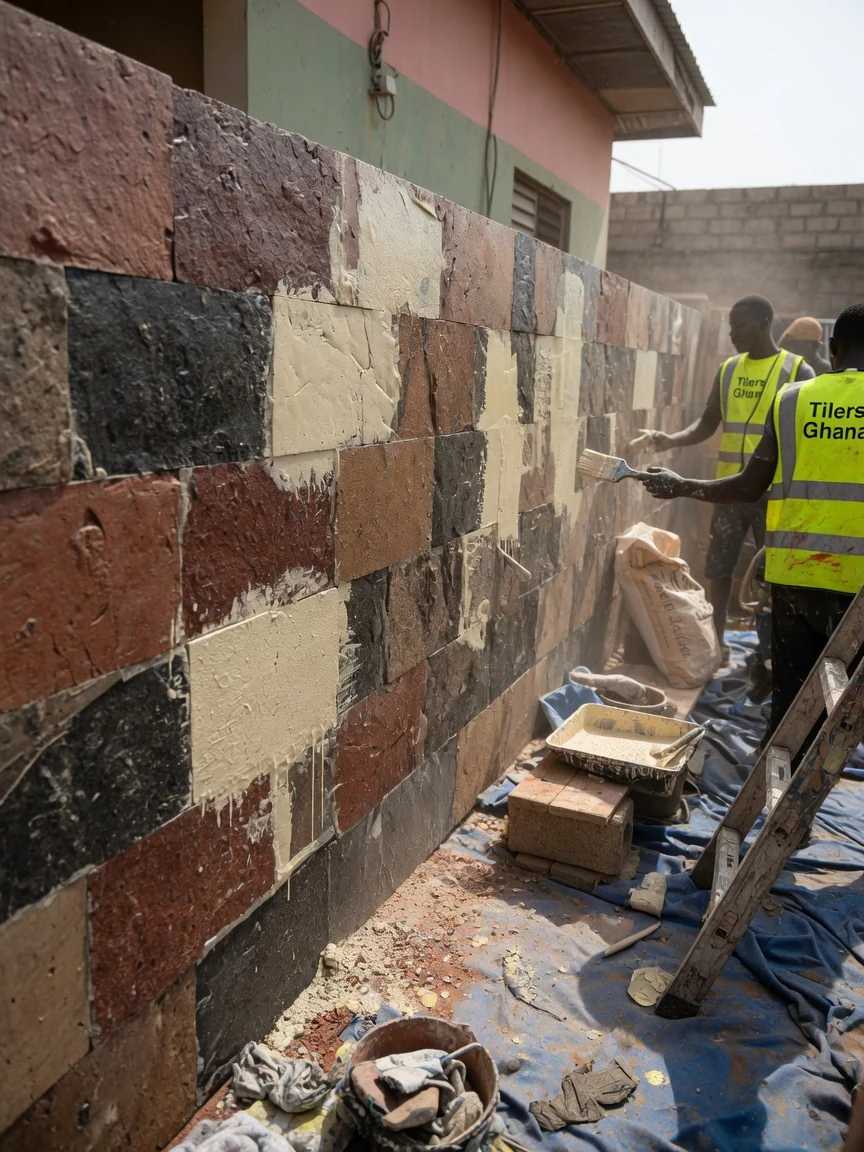
- Impregnating seal, efflorescence control & grout — a penetrating impregnating sealer is applied before and after grouting, low-water efflorescence-resistant setting prevents salt bloom, and the floor is signed off on a written QC record.
Choosing the Right Stone
| Stone | Absorption / porosity | Best for | Sealing need |
|---|---|---|---|
| Marble (Carrara, Calacatta) | Porous, translucent | Banking halls, ceremonial reception, luxury lobbies | Impregnate-seal before and after grouting; reseal on cycle |
| Granite | Dense, near-zero absorption | High-traffic concourses, thresholds, wet-prone corridors | Low — maintenance seal still beneficial |
| Travertine / limestone | Porous, voided (filled or unfilled) | Honed feature floors, residential interiors | Seal and, where unfilled, fill; efflorescence-resistant setting |
| Slate / quartzite | Variable, piece to piece | Terraces, entrances, riven-texture feature floors | Seal to measured porosity of each consignment |
What Affects the Cost
- The stone type and finish — honed, polished, filled or riven all set differently
- Its porosity and the sealing regime the stone demands
- Substrate flatness and any levelling required to bring the deck within tolerance
- Vein-matching and the wastage that careful sequencing entails
- The area, access and complexity of the floor
Every quote follows a site survey — no fixed rate before the stone and substrate are assessed.
Applications Across Ghana
- Embassy and diplomatic reception floors in Cantonments and Airport Residential
- Banking and corporate halls across Accra CBD
- Luxury residences in East Legon
- Hotel lobbies in Airport City and Spintex
Areas We Serve
Tilers Ghana sets natural stone across East Legon, Cantonments, Airport Residential, Spintex, and Tema — plus Greater Accra.
Related Services
- Large-Format Porcelain Tile Installation — rectified-edge porcelain panels with calibrated lippage control
- Substrate Preparation — levelling and flatness work that every stone floor depends on
- Heritage Tile Restoration — conservation and matching of historic and natural surfaces
- Anti-Slip & Wet Area Tiling — slip-rated stone and tile for bathrooms, pools and wet zones
Frequently Asked Questions
Why does marble stain or show shadows after laying? Translucent stone such as marble telegraphs voids and grey cement adhesive straight through to the surface as dark shadows, and porous stone wicks staining. We set on white deformable adhesive at ≥95% coverage to remove voids and colour-shadowing, and impregnate-seal before grouting so the grout slurry cannot stain the face.
What is efflorescence and how do you prevent it? Efflorescence is the white salt bloom that appears when water carries soluble salts from the bed or substrate to the stone surface and evaporates. We control it with low-water setting, proper substrate moisture management, and impregnating sealers that limit the moisture movement that drives the salts upward.
Do natural stone floors need sealing? Yes — porous stone such as marble, travertine and limestone needs a penetrating impregnating sealer to resist staining and efflorescence. Dense granite absorbs far less and needs less, but still benefits from sealing. All stone is best resealed on a maintenance cycle rather than once and forgotten.
How much does a natural stone floor cost? Cost is quoted on survey, because it varies with the stone and finish, its porosity and sealing regime, the substrate preparation required, vein-matching wastage and the area and access. We never give a fixed rate before the stone and substrate are assessed.