
Heritage Tile Restoration
Restoration of colonial-era encaustic, period geometric and mosaic, and heritage terracotta for embassies, ministerial residences and protected Accra interiors — substrate consolidation, pattern-matched infill and conservation-grade sealing. Tilers Ghana, since 1976.
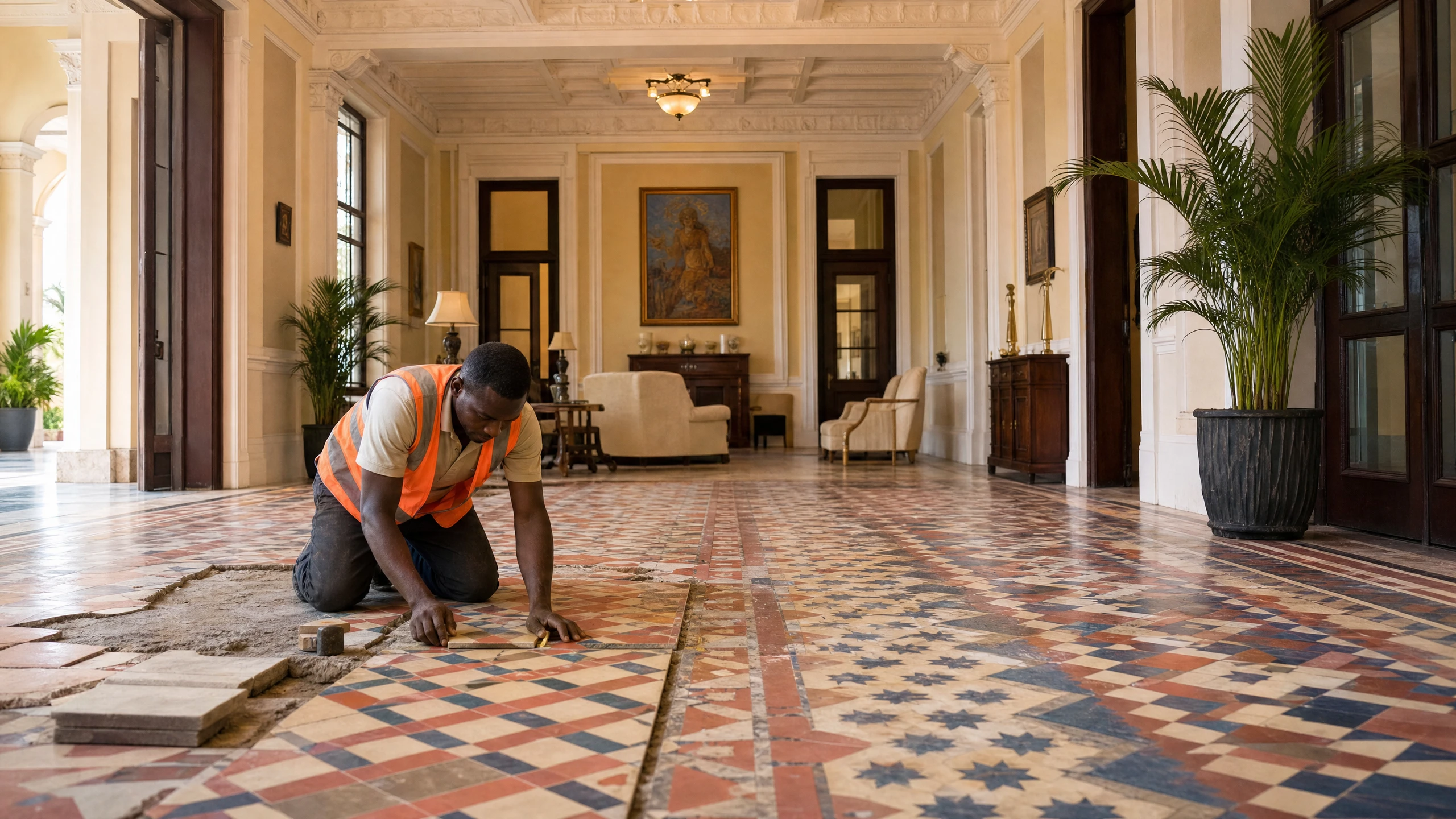
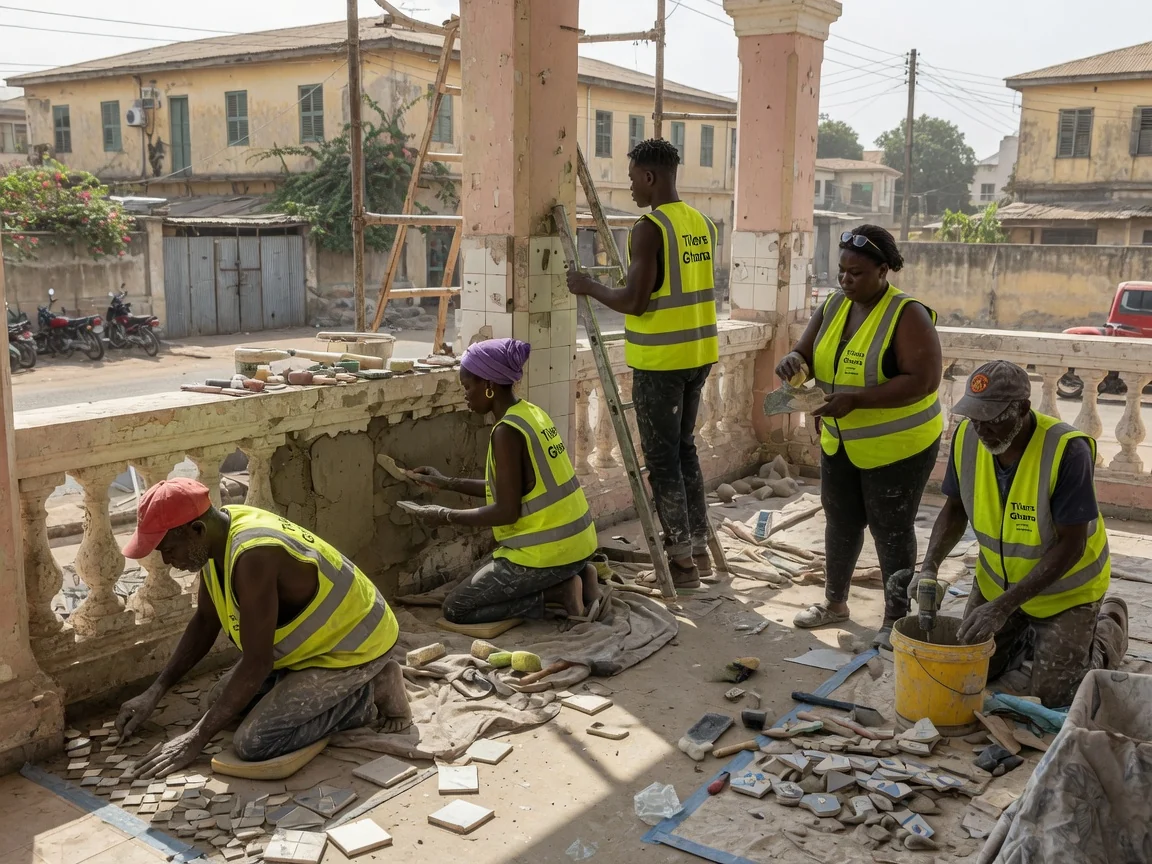
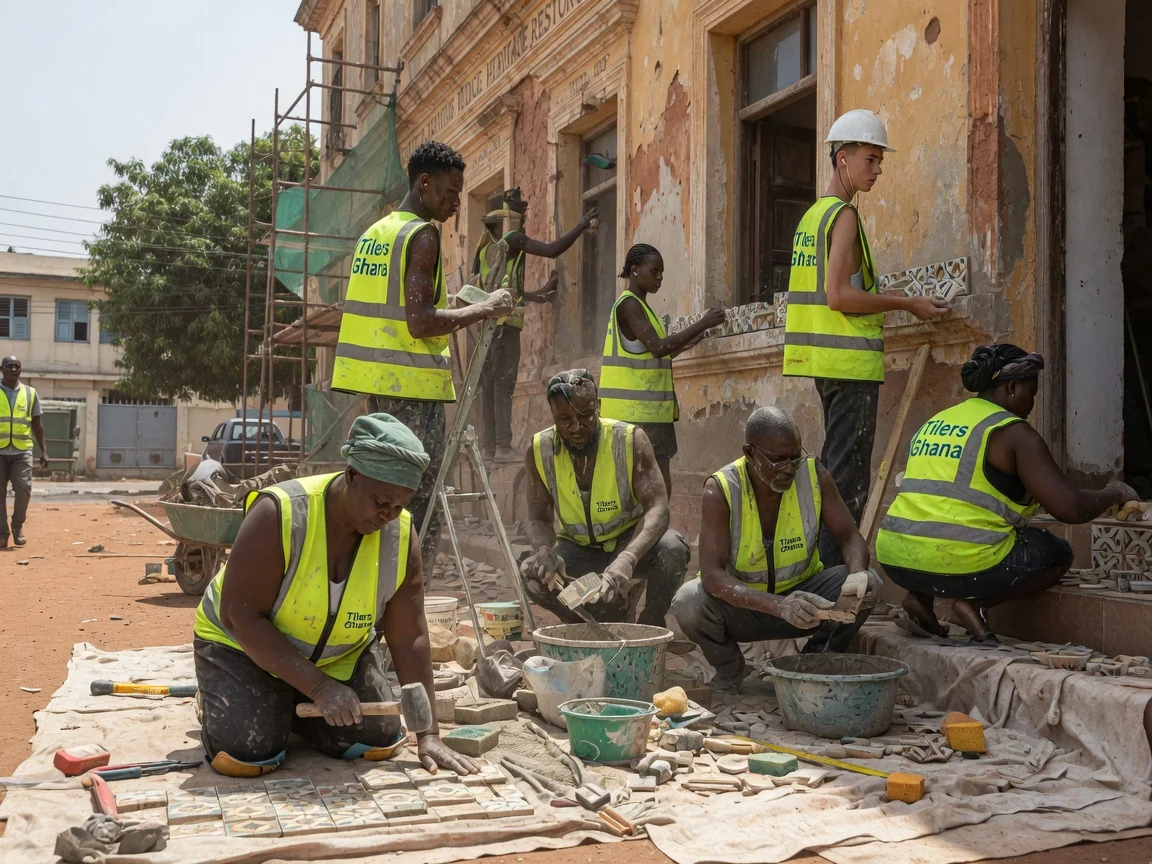
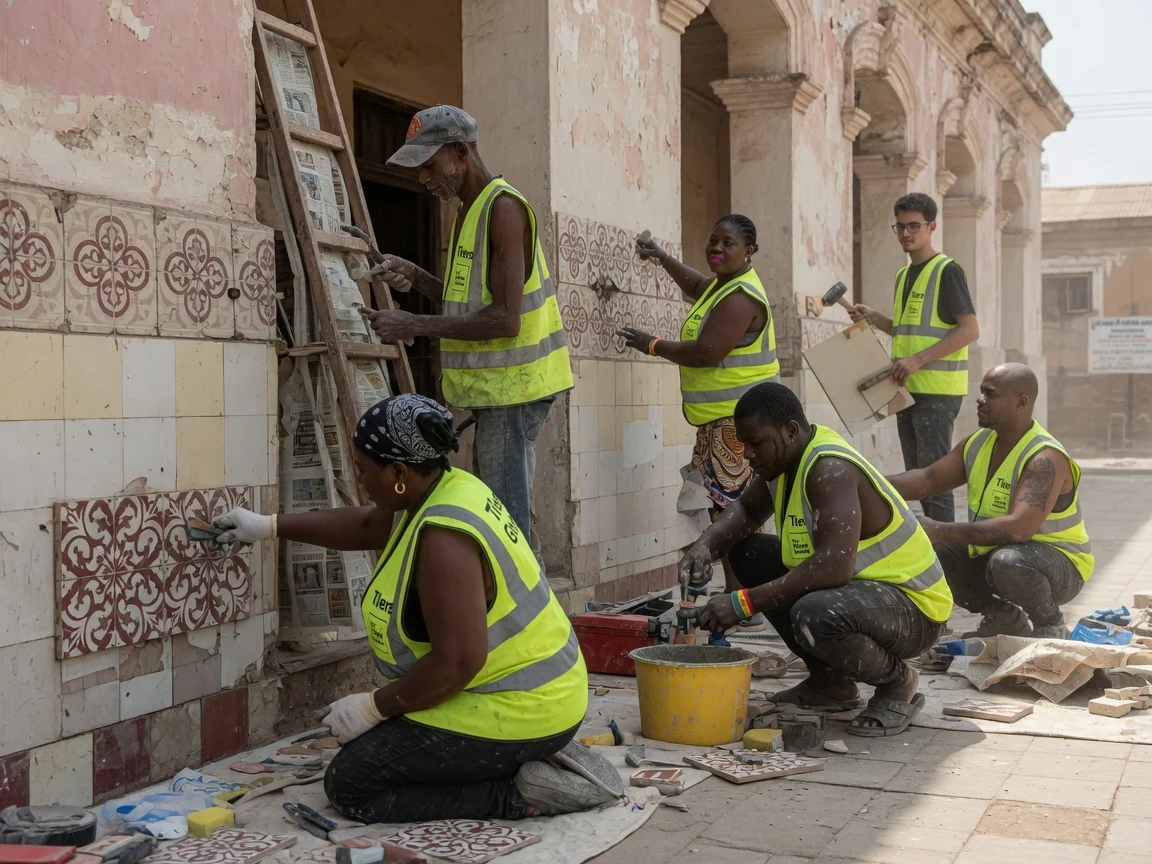
Heritage tile restoration is the conservation discipline of recovering and reinstating original period tilework — colonial-era encaustic cement tiles, period geometric and mosaic floors, and heritage terracotta — to conservation integrity. The aim is material authenticity and a seamless join between the original and the restored field, so a visitor cannot tell where one ends and the other begins. Tilers Ghana has restored heritage tile across Accra since 1976, treating each floor as part of the architectural record it belongs to.
Why Heritage Tile Restoration Demands Care in Ghana’s Conditions
Period tilework is unforgiving in Ghana’s climate. With average humidity around 81–83%, colonial-era encaustic cement tiles and heritage terracotta are porous and breathe — they were made to take up and release moisture. Seal them with the wrong, film-forming product and that moisture is trapped beneath the surface, driving efflorescence (the white salt bloom) and spalling that lifts and crumbles the face. A general tradesman treating a heritage floor like a modern porcelain one does lasting, often irreversible, damage.
The controls are specific to conservation. We use vapour-permeable impregnating sealers that let the tile breathe rather than film-forming coatings that suffocate it; compatible bedding and mortars matched to the original construction; substrate consolidation to stabilise a failing bed without ripping out sound tile; and pattern-matched infill so any reinstatement reads as part of the original field. The discipline is in respecting what the floor already is — not in imposing a modern system on it.
Heritage Tilework We Restore in Accra
Colonial-Era Encaustic Cement Tiles
Encaustic cement tiles carry their pattern through the body of the tile in coloured cement, not as a surface glaze, which is why they wear gracefully and why they can be restored. We read their pigment, dimension and pattern repeat, consolidate the bed beneath them, and pattern-match infill so a damaged colonial floor reads whole again.
Period Geometric & Mosaic Floors
Geometric and mosaic floors are assembled from small individually-set pieces in a repeating pattern, where a few lost tesserae can break the whole composition. We lift and stabilise loose sections, source or match the individual pieces by colour and dimension, and reinstate them to the original geometry so the pattern resolves cleanly across the join.
Heritage Terracotta & Quarry Tile
Heritage terracotta and quarry tile are dense, porous, fired-clay floors prized for their warmth and patina. They must be cleaned and resealed with breathable impregnating products that preserve the patina rather than glaze over it, and damaged units matched to the original clay body, dimension and finish.
Pattern-Matched Infill & Reinstatement
Where tiles are lost or beyond recovery, infill and reinstatement is the work of making new tile disappear into old. We match pigment, dimension and pattern repeat, approve samples before procurement, and set the infill to the original layout with grout joints matched to the surviving field — so the restored area reads as original, not as a patch.
The Heritage Restoration Doctrine
| Standard / control | What it governs | Why it decides the floor |
|---|---|---|
| ANSI A108 | The re-laying installation method — flatness, layout and adhesive coverage where sections are re-bedded | Reinstated tile must be set to the same installation discipline as the original field, or the restored area lippages or debonds against the surviving floor |
| ISO 13007 | Adhesive performance — compatible deformable (C2 S1) adhesive where re-bedding | A deformable bed absorbs movement and bonds reinstated tile without stressing the surviving original around it |
| TCNA EJ171 | Movement and expansion joints in the reinstated field | Restored floors still expand and contract; correctly placed movement joints prevent the reinstatement from tenting or cracking the original |
| Vapour-permeable impregnating sealer | Breathability of the finished surface | Heritage cement and terracotta must breathe; a non-film-forming impregnating sealer protects without trapping the moisture that causes efflorescence and spalling |
| Pattern, pigment & dimensional matching | Authenticity of any infill or replacement | The restored field only reads as one if pigment, dimension and pattern repeat are matched to the original and approved before procurement |
| Substrate consolidation & movement isolation | Stability of the bed beneath the tile | A failing or moving bed will fail any reinstatement; consolidating and isolating it is what makes restoration durable rather than cosmetic |
How We Restore a Heritage Tile Floor
- Condition survey & documentation — we photographically map the floor, identify tile typology and pattern repeat, assess the mortar and bed, and diagnose the cause of failure before any work begins, so the restoration is recorded against a baseline.
- Sourcing & sample approval — we match replacement and infill encaustic or geometric tile to the surviving field by pigment, dimension and pattern repeat, and approve physical samples before any procurement.
- Substrate consolidation & re-laying — we lift delaminated sections, repair and consolidate the bed, isolate movement, and re-lay to the original pattern geometry to ANSI A108 method with compatible deformable adhesive, grout joints matched to the surviving field.
- Conservation sealing & handover — we apply a vapour-permeable penetrating impregnating sealer appropriate to the tile, protect the finished floor, and inspect the result against the photographic baseline before sign-off.
Restore vs Replace
| Condition | Approach | Why |
|---|---|---|
| Surface soiling or loss of finish | Clean and reseal with a breathable impregnating sealer | The tile is sound; restoring the protective finish recovers the floor without disturbing original material |
| Localised damage to a few tiles | Lift and pattern-matched infill | Matching pigment, dimension and pattern repeat lets new tile disappear into old without replacing the whole field |
| Delamination or movement | Consolidate the substrate and relay | The fault is in the bed; stabilising and re-laying fixes the cause, not just the surface |
| Field beyond recovery | Matched replacement to original specification | Where original tile cannot be saved, replacement is matched to the original spec so the floor still reads as one |
What Affects the Cost
- The extent of loss across the floor — isolated damage versus widespread failure
- The difficulty of matching the original tile by pigment, dimension and pattern repeat
- The substrate consolidation and bed repair required beneath the tile
- The sealing regime the heritage tile demands
- The area, access and complexity of the floor
Every quote follows a site survey — no fixed rate before the floor is assessed.
Applications Across Ghana
- Embassy and diplomatic residence floors in Cantonments and Ridge
- Ministerial and protected interiors across central Accra
- Heritage hotels and period buildings
Areas We Serve
Tilers Ghana restores heritage tile across Cantonments, Ridge, East Legon, Airport Residential, and central Accra — plus Greater Accra.
Related Services
- Natural Stone Installation — marble, granite and stone set with impregnating sealers and efflorescence control
- Decorative Pattern Tiling — geometric, herringbone and feature layouts set to true pattern geometry
- Mosaic & Feature Tile Installation — small-format mosaic and feature work set piece by piece
- Substrate Preparation — bed repair, levelling and consolidation that every restored floor depends on
Frequently Asked Questions
Can old encaustic and terracotta tiles be restored rather than replaced? Yes — where the floor is part of the architectural record we restore rather than rip out. We consolidate the substrate, lift and relay damaged sections, and pattern-match infill so the original and restored field read as one. Full replacement is the last resort, reserved for areas beyond recovery and matched to the original specification.
How do you match a discontinued period tile? We read the surviving tile for its pigment, dimension and pattern repeat, then source or match encaustic and geometric tile to that exact specification. Physical samples are approved before any procurement, so nothing is committed to the floor until the match has been confirmed against the original.
Why is heritage sealing different? Heritage and cement-bodied tiles are porous and need to breathe, so we use a vapour-permeable, non-film-forming impregnating sealer. Film-forming sealers trap moisture beneath the surface and damage period tile through efflorescence and spalling — the opposite of conservation.
How much does heritage tile restoration cost? It is quoted on survey, because it varies with the extent of loss, the difficulty of matching the original tile, the substrate works required, and the area and access. We never give a fixed rate before the floor is assessed.