
Anti-Slip & Wet Area Tiling
Slip-rated tile systems for hotel pools, spa surrounds, healthcare wet areas and commercial kitchens in Accra — specified to wet DCOF ≥0.42 (ANSI A137.1) and EN 16165 R-ratings, over a waterproofed substrate set to ANSI A108. Tilers Ghana, since 1976.
Anti-slip and wet area tiling is the measured discipline of setting floors that must hold grip and stay watertight where water is constant — pool decks, spa surrounds, commercial kitchens and healthcare wet zones. It is not a finish choice but a specification: a slip-rated tile to a wet DCOF ≥0.42 (ANSI A137.1) and an EN 16165 R-rating, laid over bonded waterproofing with deformable adhesive at full coverage. Tilers Ghana has installed slip-rated wet area tiling across Accra since 1976, matching every floor to its exposure, its falls and the way it will be walked.
Why Wet Area Tiling Demands Discipline in Ghana’s Conditions
In Ghana’s 81–83% humidity, wet zones never get a chance to dry. Pool decks, spa surrounds and commercial kitchens stay wet through the day, mould grows in any grout that is not formulated against it, and water finds every breach in the assembly beneath the tile. A floor that is merely good-looking is dangerous and short-lived here: the wrong tile turns slick the moment it is wet, and a failed waterproofing layer leaks into the structure below where it cannot be reached without lifting the whole floor.
The controls are specific and non-negotiable. We set a slip-rated tile to a wet DCOF ≥0.42 per ANSI A137.1 and the EN 16165 R-rating the zone demands, lay bonded waterproofing to ANSI A118.10 with falls to the drainage, bed in deformable adhesive at ≥95% coverage so no water can track beneath, and grout with mould-resistant grout. The discipline is in the assembly and the verified slip surface — not in any single product.
Anti-Slip & Wet Area Systems We Install in Accra
Pool Decks & Surrounds (R11–R12, barefoot)
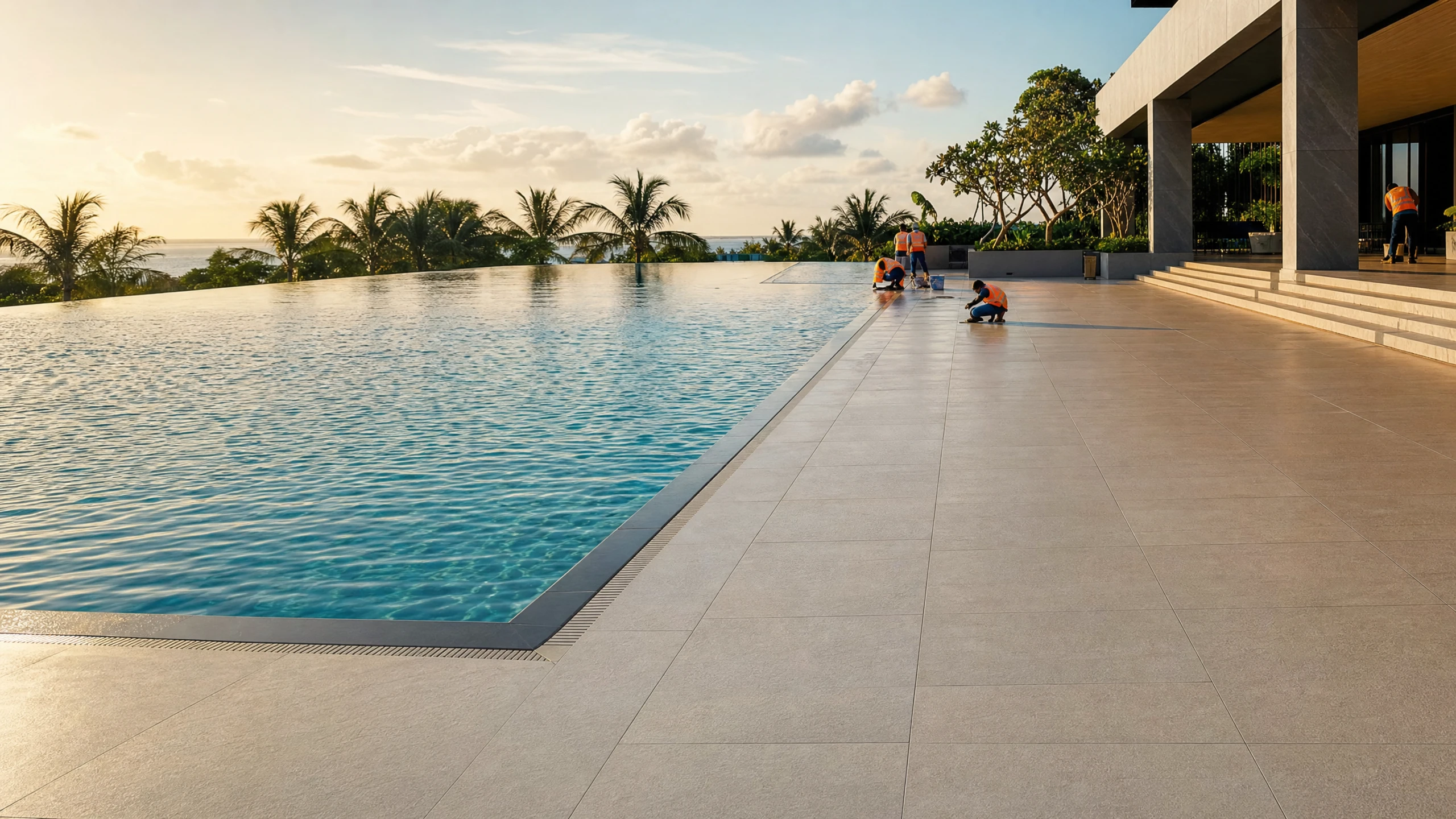
Pool decks and surrounds are walked barefoot while running with water, so they are specified to EN 16165 R11–R12 — grip that holds wet, underfoot, without an aggressive texture that abrades the foot. They sit over bonded waterproofing with falls set to the drainage so standing water never pools at the edge, and are bedded at full coverage because a hollow tile by a pool is both a slip and a lift risk.
Spa & Wet-Room Floors
Spa and wet-room floors combine constant moisture, barefoot use and frequent wash-down, so they pair a slip-rated tile with a fully tanked, bonded waterproofing layer carried up the walls and around every penetration. Falls are set to the drain, upturns and pipe collars are sealed before tiling, and mould-resistant grout keeps the joints sound in air that never fully dries.
Commercial Kitchen & Back-of-House Floors (R12–R13, grease/wash-down)
Commercial kitchen and back-of-house floors face grease, hot water and aggressive wash-down, so they are specified to EN 16165 R12–R13 — the grip that holds when the floor is wet and greasy at once. They are laid to falls toward floor gullies over a bonded membrane, with chemical- and mould-resistant grout, so the floor drains, stays sound under daily cleaning and meets hygiene expectations.
Healthcare & Changing-Room Wet Zones
Healthcare wet zones and changing rooms demand reliable grip for a mixed and often vulnerable footfall, with hygiene and drainage built in. They are set to a wet DCOF ≥0.42 baseline, stepped up to an R-rating where barefoot or running water applies, over bonded waterproofing with sealed penetrations — so the floor is safe underfoot, cleanable and watertight beneath.

The Wet Area & Slip Doctrine
| Standard | What it governs | Why it decides the floor |
|---|---|---|
| ANSI A137.1 | Wet dynamic coefficient of friction (DCOF) — the slip baseline | Sets the wet DCOF ≥0.42 baseline for level wet floors; the measured slip value here decides whether the floor is safe underfoot when wet |
| EN 16165 | R-rating ramp test method (R9–R13) for ramps, wet and barefoot zones | The ramp-method R-rating specifies grip for pool decks, kitchens and wet ramps; it steps the slip class up above the level-floor baseline where water runs or the foot is bare |
| ANSI A118.10 | Bonded waterproofing membrane | The bonded membrane is the layer that stops the leak; specified here, it makes the floor watertight beneath the tile rather than relying on grout |
| ANSI A108 | Installation method and adhesive coverage | The governing installation standard — coverage and method set here determine whether water can track beneath the tile and lift it |
| ISO 13007 | Adhesive performance — C2 S1/S2 deformable | C2 S1/S2 deformability lets the bed hold immersion and thermal movement in wet zones without debonding the tile |
| TCNA EJ171 | Movement and expansion joints | Wet floors need correctly placed movement joints to absorb thermal expansion and prevent tenting around drains and at perimeters |
Note: EN 16165 superseded DIN 51130, but the R9–R13 ramp test method survives within it — the current standard we cite is EN 16165.
How We Install an Anti-Slip Wet Area Floor
- Slip-class & exposure mapping — we agree the target wet DCOF ≥0.42 per ANSI A137.1 and the EN 16165 R-rating (R10–R13 for ramps and wet zones) for the actual use, so the floor is specified to how it will be walked.
- Waterproofing & falls — we set falls to the drainage, install a bonded waterproofing membrane to ANSI A118.10, and seal penetrations and upturns before any tile is laid.
- Setting with deformable adhesive — tiles are bedded in ISO 13007 C2 S1/S2 deformable adhesive at ≥95% coverage in wet and immersion zones, with joint and lippage discipline so water cannot track beneath.
- Grout, movement joints & verification — we grout with mould-resistant grout, place movement joints per TCNA EJ171, verify the slip surface on site against the agreed DCOF and R-rating, and sign off on a written QC record.
Choosing the Right Slip Class
| Zone | Target slip | Tile type |
|---|---|---|
| Level wet floor (bathroom, shower) | Wet DCOF ≥0.42 (ANSI A137.1) | Slip-rated ceramic or porcelain, fine micro-texture |
| Pool surround / barefoot wet zone | R11–R12 (EN 16165) | Barefoot-rated porcelain, grip without abrasion |
| Commercial kitchen | R12 (EN 16165) | Grease- and wash-down-rated porcelain, profiled surface |
| Heavy wet-industrial / wet ramp | R13 (EN 16165) | Deep-profile slip-rated porcelain or quarry tile |
What Affects the Cost
- The slip class and tile type — a barefoot R12 or kitchen R13 tile specifies differently from a level wet floor
- The waterproofing scope — full tanking and upturns cost more than a level membrane
- The falls and drainage works required to send water to the gully or drain
- The substrate condition and any levelling needed to set falls correctly
- The area, access and complexity of the wet zone
Every quote follows a site survey — no fixed rate before the wet area is assessed.
Applications Across Ghana
- Hotel pools and spas in Airport City and Cantonments
- Commercial kitchens and hospitality back-of-house across Accra
- Healthcare wet zones and changing rooms
- Executive bathrooms in East Legon and Airport Residential
Areas We Serve
Tilers Ghana installs slip-rated wet area tiling across East Legon, Cantonments, Airport Residential, Spintex, and Tema — plus Greater Accra.
Related Services
- Substrate Preparation — levelling, falls and a sound substrate that every wet floor depends on
- Mosaic & Feature Tile Installation — mosaic and feature detail for pools, spas and wet walls
- Natural Stone Installation — sealed, slip-rated stone for bathrooms and surrounds
- Heated Floor Tile Systems — warm, dry underfoot tiling for bathrooms and wet rooms
Frequently Asked Questions
What slip rating do I need for a wet area? Wet DCOF ≥0.42 per ANSI A137.1 is the baseline for level wet floors. Ramps and barefoot wet zones such as pool decks and spa surrounds step up to EN 16165 R-ratings — typically R11 to R13 — because they must hold grip while running with water and walked barefoot. We agree the target with you before specifying a tile.
Why do wet area tiles fail or leak? The failure is almost always under the tile, not on it — missing or breached waterproofing, falls that send water away from the drain, or hollow beds that let water track and lift the tile. We waterproof to ANSI A118.10, set falls to the drainage, and bed at ≥95% coverage before any tile goes down, so the assembly stops water rather than the grout line.
Can you make an existing pool or shower non-slip? Yes — by specifying a correctly slip-rated tile over a sound, waterproofed substrate. Surface treatments and coatings alone do not substitute for the right tile and a proper bed; they wear and fail. Where the existing waterproofing or falls are unsound, we rebuild that layer first, because slip rating only holds on a floor that is dry beneath.
How much does an anti-slip wet area floor cost? Cost is quoted on survey, because it varies with the slip class and tile type, the waterproofing scope, the falls and drainage works, the substrate condition and the area and access. We never give a fixed rate before the wet area is assessed.