
Mosaic & Feature Tile Installation
Micro-mosaic, glass and porcelain tessera feature walls, pool basins and statement surfaces in Accra — set with sub-millimetre joint discipline, immersion-rated ISO 13007 adhesive and movement detailing over a sound waterproofed substrate. Tilers Ghana, since 1976.
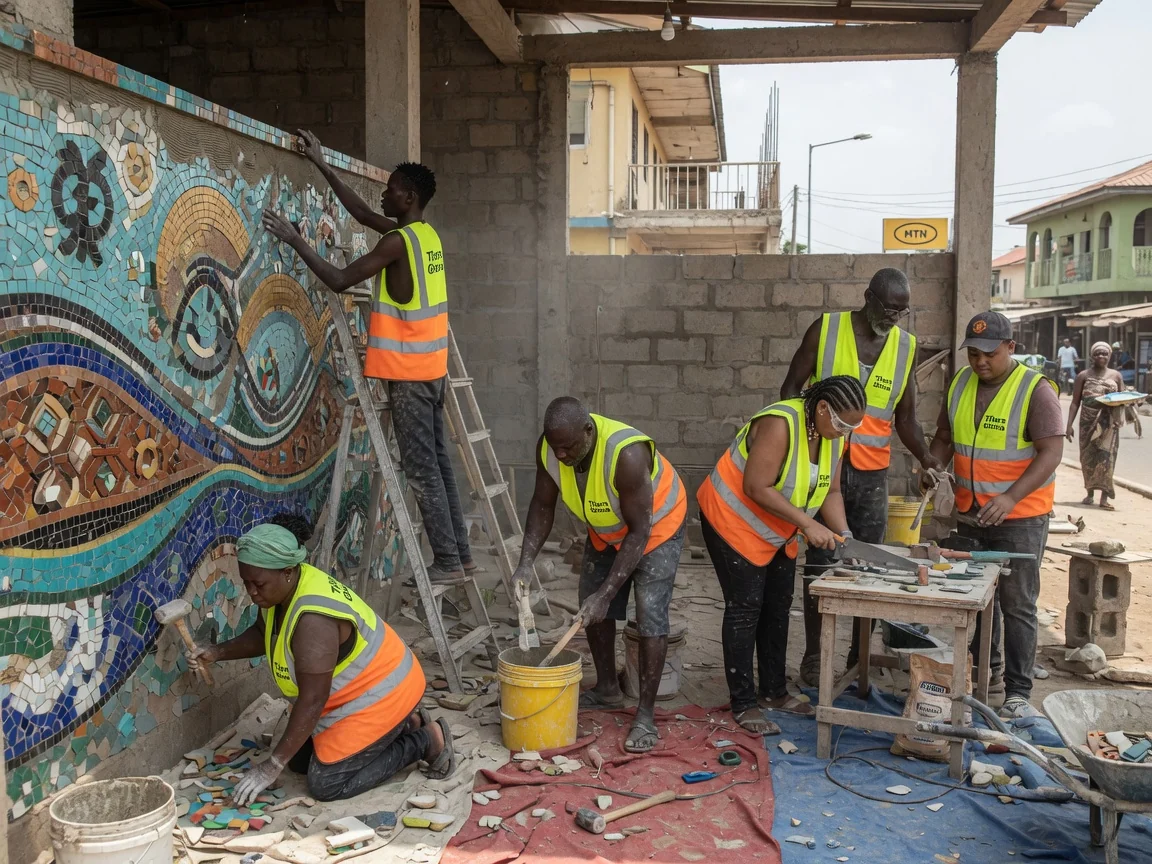
Mosaic and feature tile installation is the discipline of composing small-format glass, porcelain and stone tesserae and feature tile into continuous decorative fields — set with sub-millimetre joint discipline and the right bed for the exposure. Unlike standard field tiling, every void and any grey adhesive behind a translucent tessera reads straight through to the face, so the work demands setting-out precision and full-coverage support. Tilers Ghana has installed mosaic and feature tile across Accra since 1976.
Why Mosaic & Feature Tiling Demands Precision in Ghana’s Conditions
Mosaic surfaces in Ghana carry an exposure problem that field tile does not. Pools and wet feature walls stay wet, and at an average humidity of roughly 81–83% the bed beneath them rarely fully dries. Glass tesserae compound the risk because they are translucent and unforgiving: any void or band of grey adhesive behind the glass shows through the face as a permanent shadow that cannot be polished out. A mosaic set by a generalist on patchy coverage reveals these faults publicly, and re-setting a feature wall or a basin is a strip-out, not a touch-up.
The controls are precise and non-negotiable. We set tesserae in white deformable C2 S1/S2 immersion-rated adhesive to ISO 13007 at full coverage so no void or grey cement shows through, lay a bonded waterproofing membrane to ANSI A118.10 below pools and wet zones, work to a sub-millimetre setting-out plan so the pattern reads true, and finish with a chemical-resistant grout. The discipline is in the setting-out and the coverage — not in any single product.
Mosaic & Feature Tile We Install in Accra
Glass & Porcelain Micro-Mosaic
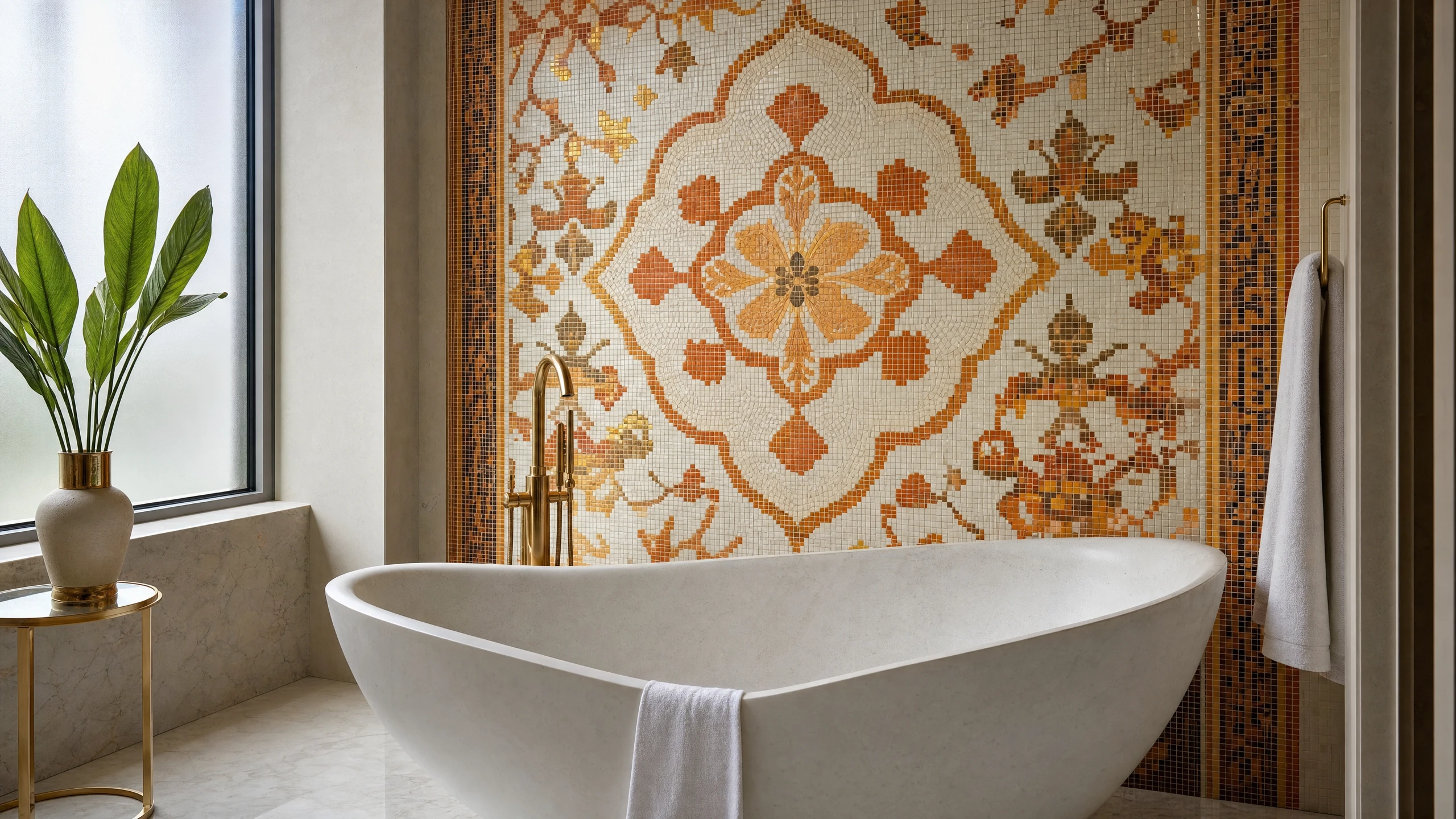
Glass and porcelain micro-mosaic on sheet — typically 20 × 20 mm and 25 × 25 mm units on mesh — is the signature of premium bathrooms and statement surfaces. Glass is translucent, so it must be back-buttered and set at full coverage in white adhesive, otherwise voids and grey bands read straight through the face. Porcelain tesserae are more forgiving but still depend on registered setting-out so the grid stays even across the field.
Pool & Spa Basin Mosaic (full immersion)
Pool and spa basin mosaic lives under continuous immersion, which is the most demanding exposure in tiling. The basin needs a sound bonded waterproofing layer to ANSI A118.10 below the mosaic, an immersion-rated white deformable adhesive at full coverage, and a chemical-resistant grout that holds up against pool chemistry. Every step exists to keep water out of the substrate, not just off the face.
Feature Walls & Statement Surfaces
Feature walls and statement reception surfaces are where mosaic does its visual work — but a vertical mosaic field still depends on full-coverage setting and accurate registration so the pattern does not drift course to course. Movement joints are placed per TCNA EJ171 so thermal and structural movement does not crack the field or open the joints.
Stone & Metal Tessera Features
Stone and metal tessera features bring texture and contrast to a mosaic field, but each material wants a compatible bed: porous stone is sealed before setting so grout cannot stain it, and metal tesserae are set with a bed matched to their backing. We adapt the adhesive and grout to the mix of materials rather than treating every tessera the same.

The Mosaic Setting Doctrine
| Standard | What it governs | Why it decides the surface |
|---|---|---|
| ANSI A108 | The installation method itself — coverage, setting-out and substrate flatness | This is the reference installation standard; the full coverage and flatness fixed here decide whether voids or grid drift appear in the mosaic |
| ANSI A118.10 | Bonded waterproofing membranes for pools and wet zones | A pool basin or wet feature wall needs a sound bonded membrane below the mosaic, or water reaches the substrate however good the adhesive is |
| ISO 13007 | Adhesive performance — white deformable C2 S1/S2, immersion-rated | A white deformable immersion-rated adhesive at full coverage keeps grey cement and voids from showing through translucent glass and holds in submerged basins |
| TCNA EJ171 | Movement and expansion joints | Mosaic fields need correctly placed movement joints to absorb thermal and structural movement and avoid cracking or tenting |
| ANSI A118 | Immersion-rated mortar and grout selection | The mortar and grout grades for full-immersion and wet exposure are selected here, including chemical-resistant grout for pools and spas |
How We Install a Mosaic Feature
- Setting-out & substrate check — we draw a scaled setting-out plan for the pattern repeat, confirm substrate flatness to ANSI A108, and in wet or immersion zones lay a bonded waterproofing membrane to ANSI A118.10 before any sheet is set.
- Material inspection & prep — each delivery of sheets and tesserae is inspected for shade and calibration, sequenced for a consistent field, and porous units are sealed before setting so cement grout cannot stain the face.
- Thin-bed setting — tesserae are set in white deformable ISO 13007 C2 S1/S2 adhesive, immersion-rated for pools, at full coverage and back-buttered, registered to sub-millimetre joint alignment course by course so the pattern reads true.
- Grouting, movement joints & finish — we grout to specification, place movement joints per TCNA EJ171, clean the face with pH-neutral agents, and sign off on a written QC record before handover.
Matching the Mosaic to the Setting
| Setting | Tessera type | Key requirement |
|---|---|---|
| Feature wall | Glass / porcelain micro-mosaic | Scaled setting-out and full-coverage back-buttering so no void or grid drift shows |
| Pool basin | Glass / porcelain (full immersion) | Bonded waterproofing to ANSI A118.10 below, immersion-rated white deformable adhesive above |
| Spa wet-room | Slip-rated porcelain / glass mix | Slip resistance underfoot with a chemical-resistant grout for spa chemistry |
| Stone / metal feature | Stone or metal tessera | A compatible bed — porous stone sealed before setting, metal set to its backing |
What Affects the Cost
- The material and intricacy of the pattern — fine micro-mosaic and tight repeats take longer than simple fields
- Whether immersion and waterproofing are required for a pool, spa or wet feature wall
- The setting-out complexity and how exacting the registration must be
- The substrate condition and any preparation needed to bring it into tolerance
- The area, access and overall complexity of the surface
Every quote follows a site survey — no fixed rate before the surface is assessed.
Applications Across Ghana
- Premium bathrooms and spa basins in East Legon and Airport Residential
- Hotel pool basins and feature walls in Airport City and Cantonments
- Reception and statement surfaces in corporate and hospitality interiors
Areas We Serve
Tilers Ghana installs mosaic and feature tile across East Legon, Cantonments, Airport Residential, Spintex, and Tema — plus Greater Accra.
Related Services
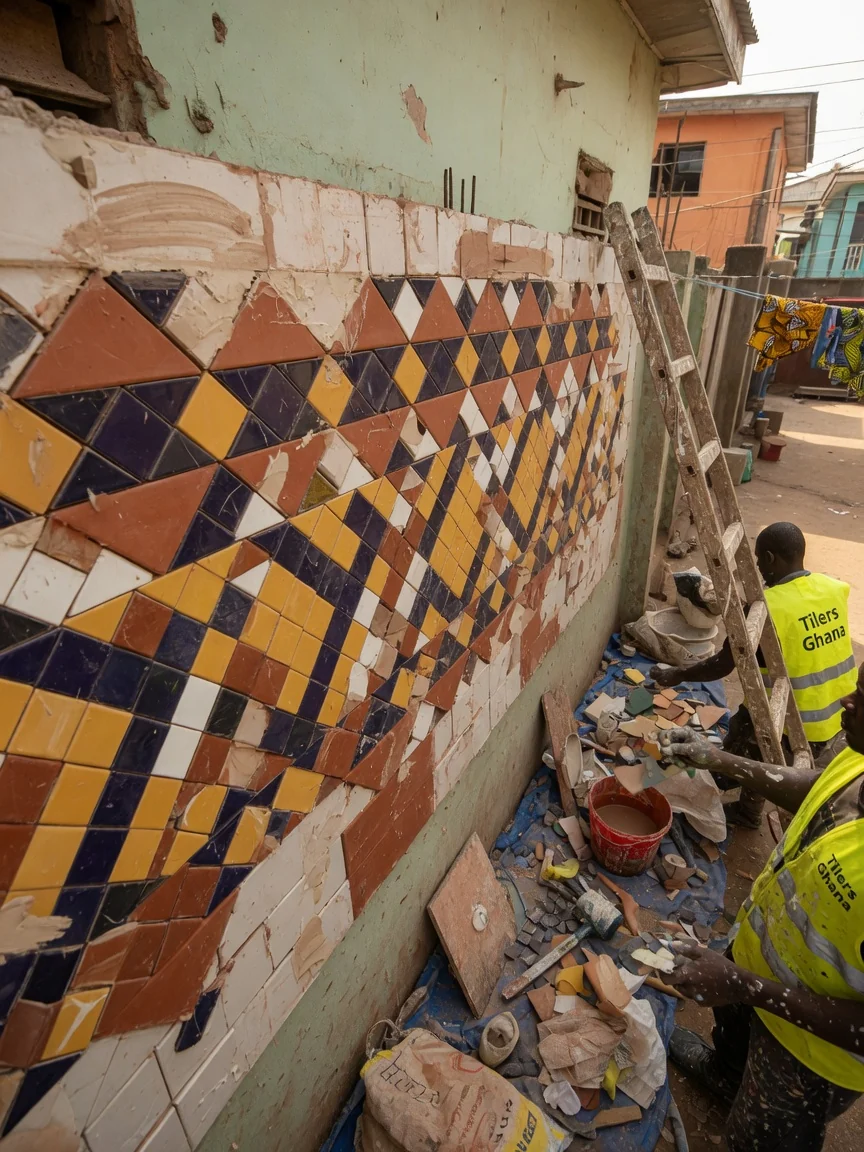
- Decorative Pattern Tiling — geometric and bespoke pattern fields set to a registered setting-out plan
- Anti-Slip & Wet Area Tiling — slip-rated tile and waterproofing for bathrooms, pools and wet zones
- Natural Stone Installation — marble, granite and travertine for reception and statement surfaces
- Substrate Preparation — the levelling, flatness and waterproofing every mosaic depends on
Frequently Asked Questions
What adhesive and grout for a glass mosaic pool? A white deformable ISO 13007 C2 S1/S2 adhesive rated for full immersion, set at full coverage, with a chemical-resistant grout. A pool basin also needs a sound bonded waterproofing layer below the mosaic — immersion-rated adhesive over a failed membrane will still let water reach the substrate.
Why do mosaic sheets show grid lines or drift? Grid lines and pattern drift come from poor setting-out and inconsistent adhesive coverage that lets sheets wander course to course. We work from a scaled setting-out plan and register every course so the joints stay even and the pattern reads true across the whole field.
Can mosaics go on a feature wall and a pool? Yes — both feature walls and full-immersion basins are within our work, but each needs the correct substrate, immersion-rated adhesive and movement detailing for its exposure. Glass tesserae in particular are back-buttered for full support so no voids show through the translucent units.
How much does a mosaic feature cost? It is priced on survey, because it varies with the material and intricacy of the pattern, whether immersion and waterproofing are required, the setting-out complexity, the substrate preparation needed, and the area and access. We never give a fixed rate before the surface is assessed.