
Large-Format Porcelain Tile Installation
Specification-grade large-format porcelain (≥600×600 mm rectified-edge, up to 1200×2400 mm slabs) for premium Accra hotel lobbies, corporate atriums, and executive interiors — set to ANSI A108 / ISO 13007 C2 S1 with ≥95% mortar coverage, back-buttering, and calibrated lippage control. Tilers Ghana, since 1976.
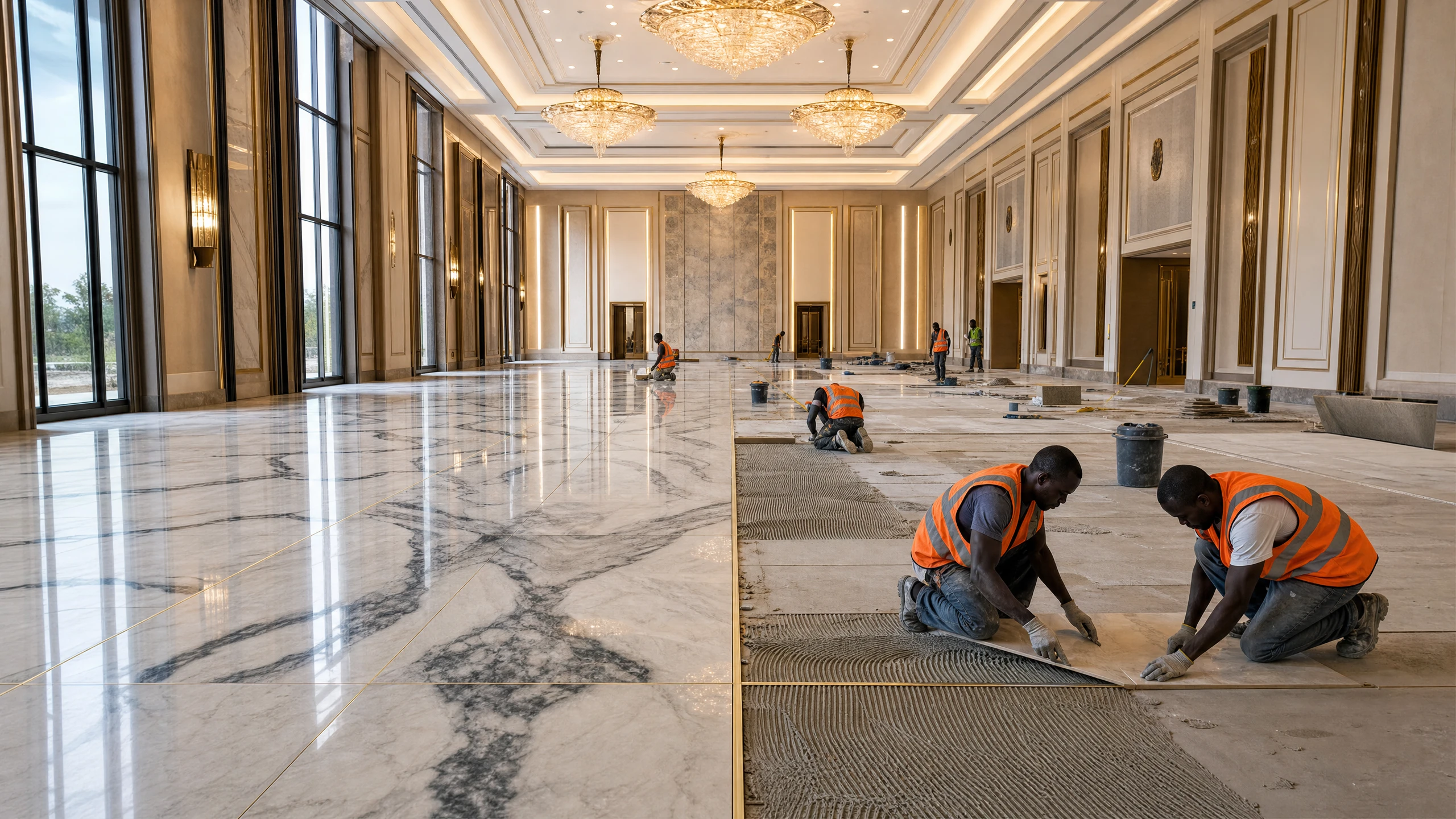
Large-format porcelain tile installation is the discipline of setting rectified-edge porcelain panels measuring 600×600 mm or greater — through 900×900 mm and slab formats of 600×1200 mm up to 1200×2400 mm — across floor and wall planes to a flatness, coverage, and lippage standard that ordinary tiling never reaches. The porcelain itself is the most stable surface available: classified to EN 14411 group BIa with water absorption of 0.5% or less, it does not move with moisture. Everything that can fail in a large-format floor happens beneath the tile, not within it. Tilers Ghana has set large-format porcelain across Accra since 1976.
Why Large-Format Porcelain Demands Precision in Ghana’s Conditions
Large panels are unforgiving of substrate movement. The bigger the tile, the more a millimetre of substrate deviation or a few percent of missing mortar coverage is amplified into a hollow spot, a lipped edge, or a cracked panel. In Ghana’s persistent 81–83% relative humidity, the temptation is to blame moisture — but the porcelain absorbs 0.5% water or less per EN 14411, so the panel is never the problem. The failures come from voids under the tile and from substrate movement that the rigid panel cannot accommodate.
The answer is method, not material. We achieve ≥95% mortar coverage by notch-trowelling the substrate and back-buttering each panel, bed every tile in a deformable ISO 13007 C2 S1 adhesive that absorbs minor substrate stress, and detail correct movement joints per TCNA EJ171 so the floor has somewhere to go. A large-format porcelain floor set this way reads as a single monolithic plane and stays that way.
Large-Format Porcelain Systems We Install in Accra
Rectified-Edge Floor & Wall Panels (600×600 to 900×900)
The workhorse of premium interiors: rectified-edge porcelain in 600×600 and 900×900 mm, set with minimal grout joints for a near-seamless plane across lobby floors, corridors, and feature walls. Rectification means the edges are machined dead-square, so tight joints stay consistent across the whole field.
Slab-Format Porcelain (600×1200, 1200×2400 — feature walls, vanities)
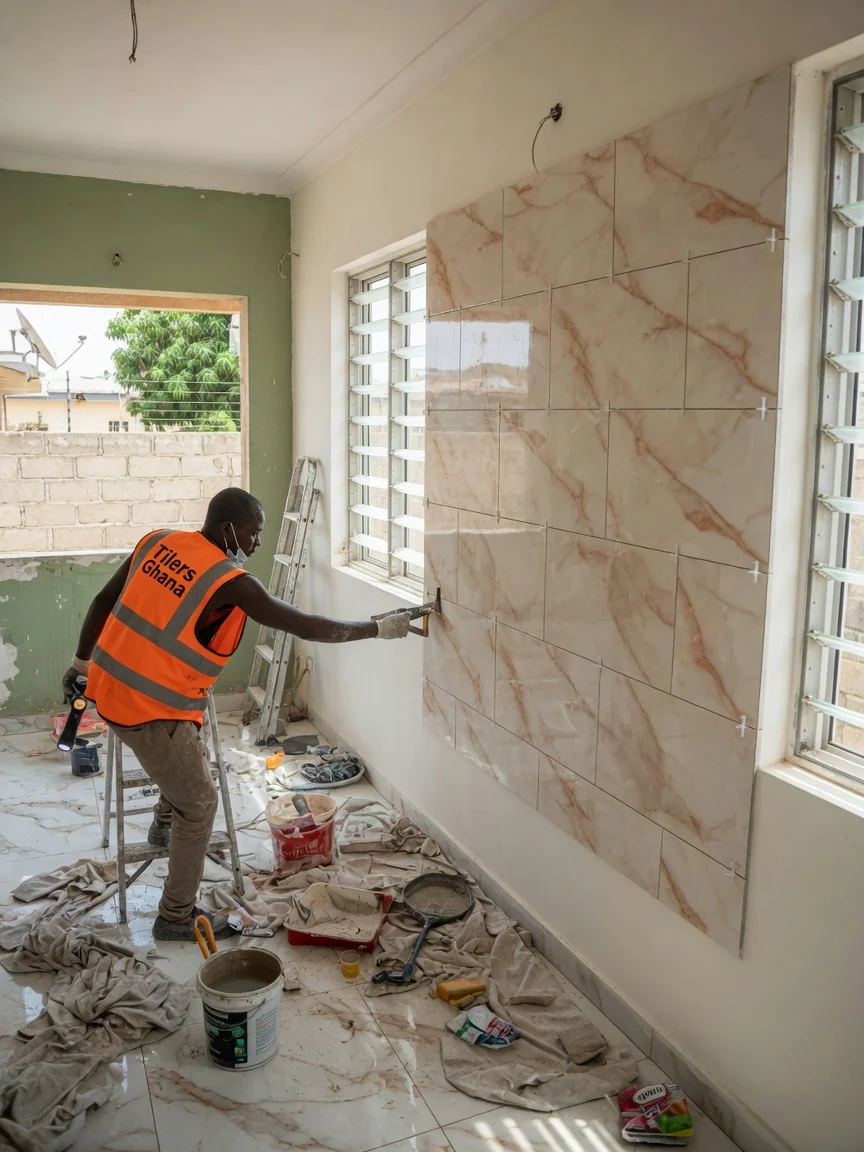
Large slabs in 600×1200 mm and full 1200×2400 mm format for feature walls, vanity surrounds, and statement floors. At this size the flatness and coverage discipline is absolute — we survey, level, back-butter, and clip every panel so the slab sits fully supported and flush with its neighbours.
Outdoor & Terrace Porcelain (20mm pavers, frost/UV-stable)
20 mm structural porcelain pavers for terraces, pool surrounds, and external walkways — frost- and UV-stable, with the same BIa low-absorption body, set on the appropriate exterior method with drainage and movement detailing for Ghana’s wet-season loading.
Bookmatched Porcelain Slab Features
Mirror-matched slab pairs for vanities, reception desks, and feature walls where the veining flows symmetrically across the joint. Bookmatching is a setting-out and dry-lay discipline as much as an installation one: the panels are sequenced and matched before a single bed is opened.
The Large-Format Setting Doctrine
| Standard | What it governs | Why it decides the floor |
|---|---|---|
| ANSI A108 | Large-format installation method, including flatness ≤3 mm under a 2.4 m straightedge and mortar coverage | Sets the flatness and ≥95% coverage thresholds that keep big panels supported and lippage-free |
| ISO 13007 | Adhesive classification — C2 improved, S1/S2 deformable | A deformable C2 S1 bed absorbs minor substrate stress instead of transmitting it into the rigid panel |
| EN 14411 | Porcelain classification — water absorption ≤0.5%, group BIa | Confirms the body is dense and dimensionally stable; the panel is not the failure point in humidity |
| TCNA EJ171 | Movement and expansion joints | Gives the floor controlled places to move so thermal and structural stress does not crack panels |
| Substrate flatness & deflection | Deck flatness and structural deflection within L/360 | A deflecting or uneven deck telegraphs straight into large panels; it is corrected before tiling, never after |
How We Install a Large-Format Porcelain Floor
-
Substrate flatness survey & deflection check — We survey the substrate for flatness to ≤3 mm under a 2.4 m straightedge per ANSI A108, confirm structural deflection is within L/360, and map moisture and movement-joint positions before any tile is set.
-
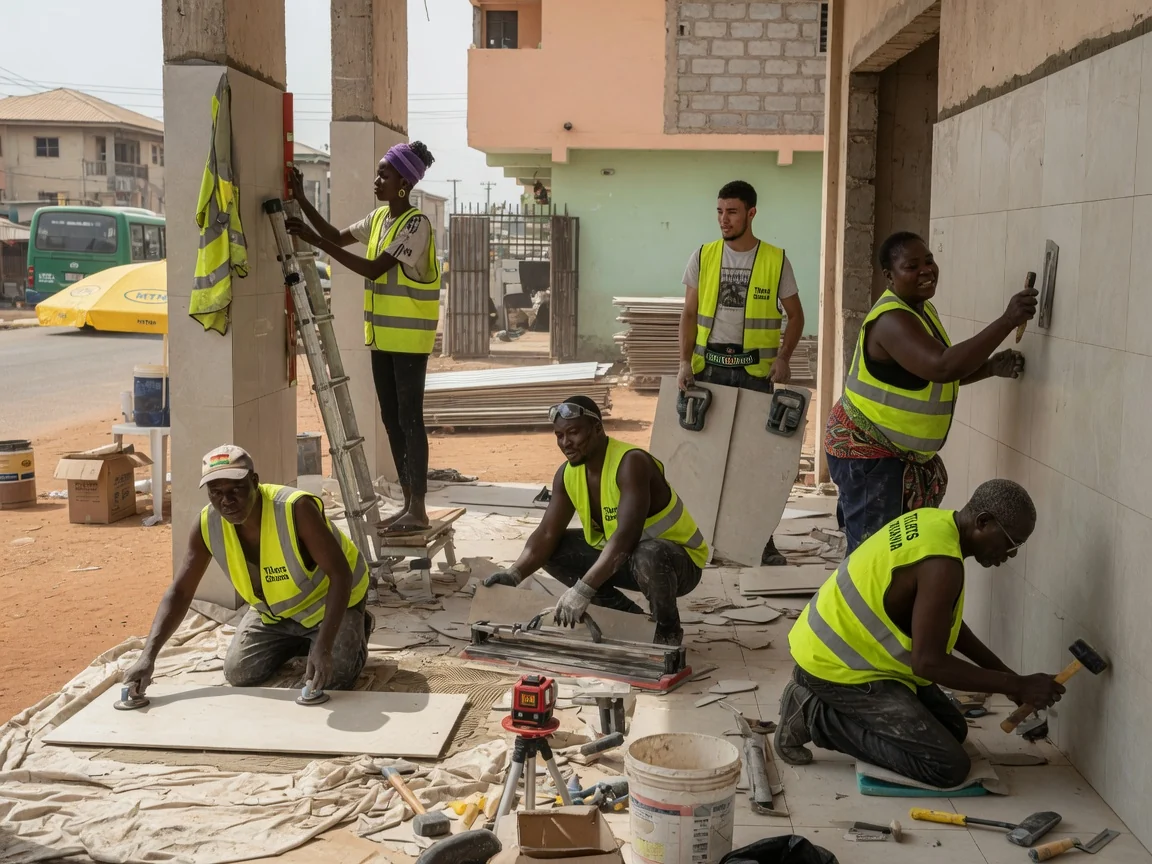
Layout, dry-lay & setting-out — We strike a centre-line layout, dry-lay panels to confirm pattern and shade-batch sequencing, and plan perimeter cuts so the largest panels read cleanly across the principal sightlines.
-
Full-coverage bedding — Panels are bedded in an ISO 13007 C2 S1 deformable adhesive, notch-trowelled on the substrate and back-buttered on the tile to reach ≥95% mortar coverage, with leveling clips and wedges set for lippage control.
-
Movement joints, grouting & handover — We detail perimeter and field movement joints per TCNA EJ171, grout to specification, inspect the finished plane under raking light for lippage, and issue a signed QC record at handover.
Choosing the Right Large-Format System
| Format | Best for | Key setting requirement |
|---|---|---|
| 600×600 mm | Lobby and corridor floors, near-seamless general planes | Flat substrate and ≥95% coverage; rectified edges for tight, consistent joints |
| 900×900 mm | Premium floors where fewer joints elevate perceived scale | Tighter flatness tolerance; back-buttering on every panel |
| 600×1200 mm | Feature walls, statement floors, vanity runs | Deformable C2 S1 bed and leveling clips to hold lippage ≤1 mm |
| 1200×2400 mm slab | Bookmatched feature walls, reception desks, statement floors | Absolute flatness, full back-butter to ≥95% coverage, mechanical handling |
| 20 mm outdoor pavers | Terraces, pool surrounds, external walkways | Frost/UV-stable body, exterior method with drainage and movement detailing |
What Affects the Cost
- Panel size and rectification — larger and rectified panels demand tighter tolerances and more handling
- Substrate flatness and the levelling needed — out-of-flat decks require screed or self-levelling before tiling
- Leveling system and coverage discipline — clip systems and back-buttering for ≥95% coverage add labour
- Area and access — site logistics, floor count, and protection affect the programme
- Movement-joint detailing — perimeter and field joints per TCNA EJ171 are designed to the room
Every quote follows a site survey — no fixed rate is given before the substrate is assessed.
Applications Across Ghana
- Hotel lobbies and atriums in Airport City and Cantonments
- Corporate and banking halls across the Accra CBD
- Executive residences in East Legon and Airport Residential
- Retail flagships along Spintex
Areas We Serve
Tilers Ghana sets large-format porcelain across East Legon, Cantonments, Airport Residential, Spintex, and Tema — plus Greater Accra.
Related Services
- Substrate Preparation
- Natural Stone Installation
- Heated Floor Tile Systems
- Decorative Pattern Tiling
Frequently Asked Questions
Why do large-format tiles crack or sound hollow?
It is almost always voids under the tile — from less than 95% mortar coverage — combined with a substrate out of flatness or deflection. Large format is unforgiving of both. We back-butter and bed every panel to ≥95% coverage per ANSI A108 and set leveling clips so the tile is fully supported.
What size counts as large-format porcelain?
Any panel ≥600×600 mm is large-format; we set up to 1200×2400 mm slab panels. The larger the panel, the tighter the flatness and mortar-coverage requirement becomes.
How do you stop lippage on big tiles?
A flat substrate, a ≥95% mortar bed, back-buttering, and a calibrated leveling-clip system held to ≤1 mm across the joints. Lippage on large format is engineered out before grouting, not corrected after.
How much does a large-format porcelain floor cost?
It is quoted on survey. The price varies with panel size, substrate condition and levelling needed, area, and access — no fixed rate is given before a site survey.