
Heated Floor Tile Systems
Electric mat and hydronic warm-floor systems beneath specification-grade tile for premium Accra bathrooms and master suites — set over an uncoupling/anti-fracture membrane (ANSI A118.12) with deformable ISO 13007 adhesive and movement accommodation. Tilers Ghana, since 1976.
A heated floor tile system is an electric resistance mat or a hydronic warm-water circuit set beneath the tile, delivering radiant warmth through the floor plane rather than through forced air. The comfort is the easy part; the engineering is movement accommodation. Every time a heated floor cycles up to temperature and back down, the whole assembly expands and contracts — and unless the tile is isolated from that movement, the bond is what fails. Tilers Ghana has installed heated tile floors across Accra since 1976.
Why Heated Tile Floors Demand Movement Control in Ghana’s Conditions
A heated floor is a floor that never stops moving. Each heating cycle drives the slab and the tile through expansion and contraction, and a rigid bond with no relief built into it eventually lets go — the tile debonds, the grout joints open, and the field cracks. The heat is not the enemy; the lack of isolation is. A heated tile floor lives or dies on whether the tile can move independently of the substrate beneath it.
The controls are method, not material. We set the tile over an uncoupling/anti-fracture membrane (ANSI A118.12) that isolates the tile from substrate cracking and thermal movement, bed every tile in a deformable C2 S1/S2 adhesive to ISO 13007 that absorbs cyclical stress instead of transmitting it, detail movement joints per TCNA EJ171 so the floor has somewhere to expand, and commission with a controlled first heat-up only after full cure. A heated floor built this way stays sound through every heating season.
Heated Floor Tile Systems We Install in Accra
Electric Heating Mats (retrofits, bathrooms)
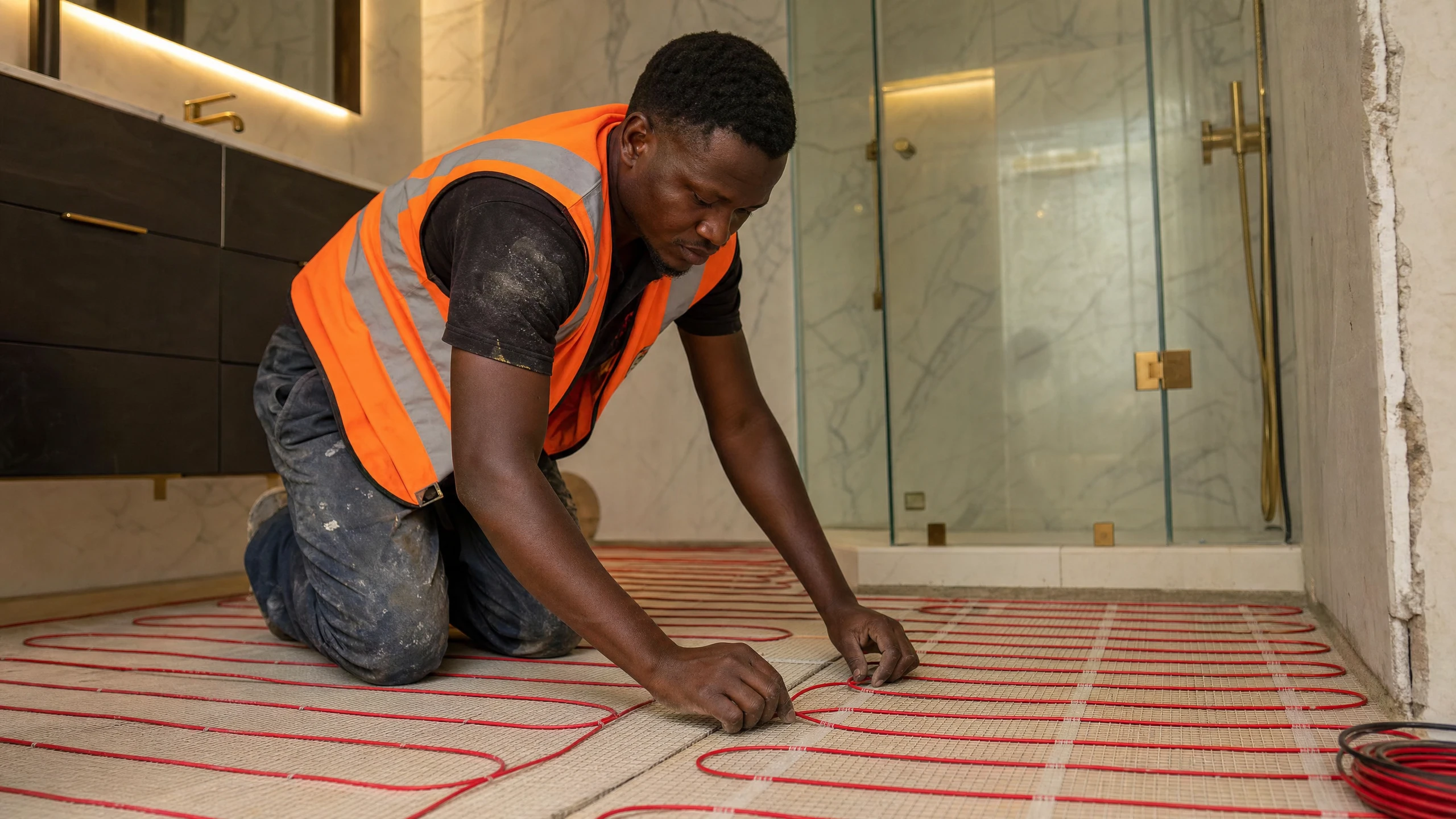
Thin electric resistance mats are the workhorse of bathrooms, master ensuites, and retrofits where build-up height is tight. The mat is set against the tile setting-out, embedded where required, and continuity-tested before tiling — then isolated from the tile by the uncoupling membrane so the daily heat cycle never reaches the bond as raw stress.
Hydronic Warm-Water Systems (large areas, whole-floor)
Hydronic warm-water circuits using cross-linked PEX pipe suit larger areas and whole-floor systems where even, economical heat across a wide plane is the brief. The circuit is laid, pressure-tested, and embedded before tiling, with the same movement detailing carried across the full field so the larger heated area moves as a controlled assembly.
Uncoupling-Membrane Heated Assemblies
The membrane is the part that makes a heated floor a tiling system rather than a gamble. We build the heated assembly over an uncoupling/anti-fracture membrane to ANSI A118.12 — the layer that decouples the tile from substrate cracking and thermal movement — so electric and hydronic systems alike sit on a base engineered to move without taking the tile with it.
Heated Stone & Large-Format Floors
Dense natural stone and large-format porcelain conduct heat well and read beautifully as warm floors, but both are unforgiving of movement. We carry the full doctrine — uncoupling membrane, deformable adhesive, movement joints, controlled heat-up — across heated stone and large-format installations so the heat warms the floor without cracking the slab or the bond.
The Heated-Floor Doctrine
| Standard | What it governs | Why it decides the floor |
|---|---|---|
| ANSI A118.12 | Uncoupling/anti-fracture membrane performance | Isolates the tile from thermal movement and substrate cracking — the essential layer that keeps a heated floor sound |
| ANSI A108 | Installation method and substrate flatness | Sets the flatness and method thresholds so the heated assembly is fully supported before tiling |
| ISO 13007 | Adhesive classification — deformable C2 S1/S2 | A deformable bed absorbs the cyclical expansion and contraction of a heated floor instead of transmitting it into the tile |
| TCNA EJ171 | Movement and expansion joints | Gives the heated floor controlled places to move so thermal stress does not crack the field |
| Substrate deflection | Structural deflection within L/360 | A deflecting deck telegraphs straight into a heated assembly; it is corrected before the membrane goes down, never after |
How We Install a Heated Tile Floor
-
System design & substrate check — We confirm electric mat versus hydronic, plan the heating layout against the tile setting-out, and verify substrate flatness per ANSI A108 and structural deflection within L/360 before any element is set.
-
Uncoupling/anti-fracture membrane — We install an uncoupling membrane to ANSI A118.12 to isolate the tile from thermal movement and substrate cracking — the essential layer under a heated floor.
-
Heating element install & test — We set the electric mat or hydronic PEX circuit, embed it in self-levelling compound where required, and pressure- or continuity-test the system before a single tile is laid.
-
Tiling, controlled commissioning & handover — We set tile in a deformable ISO 13007 C2 S1/S2 adhesive, grout to specification, run a controlled gradual first heat-up only after full cure, and issue a signed QC record at handover.
Choosing Electric vs Hydronic
| System | Best for | Key tiling requirement |
|---|---|---|
| Electric mat | Smaller rooms, bathrooms, master ensuites, and retrofits with tight build-up | Uncoupling membrane, deformable adhesive, and a controlled first heat-up after full cure |
| Hydronic PEX | Larger areas and whole-floor systems where even, economical heat is the brief | Uncoupling membrane, deformable adhesive, and movement joints carried across the full field |
| Both | Any heated tile floor, electric or hydronic | Uncoupling membrane (ANSI A118.12), deformable C2 S1/S2 adhesive, and controlled commissioning heat-up |
What Affects the Cost
- System — electric mat or hydronic warm-water circuit, each with different material and labour profiles
- Area & layout — floor size, room shape, and fixture footprints that the heating layout must work around
- Uncoupling membrane — the anti-fracture isolation layer that every heated floor requires
- Tile type — porcelain, dense stone, or large-format, each with its own setting discipline
- Substrate — flatness and any levelling or deflection correction needed before the membrane goes down
Every quote follows a site survey — no fixed rate before the floor is assessed.
Applications Across Ghana
- Premium bathrooms and master suites in East Legon, Cantonments, and Airport Residential
- Wellness rooms and spas in Airport City
- Executive interiors across Greater Accra
Areas We Serve
Tilers Ghana installs heated tile floors across East Legon, Cantonments, Airport Residential, Spintex, and Tema — plus Greater Accra.
Related Services
- Large-Format Porcelain Tile Installation
- Natural Stone Installation
- Substrate Preparation
- Anti-Slip & Wet Area Tiling
Frequently Asked Questions
Why do heated tile floors crack?
Thermal expansion and contraction stress the bond every time the floor heats and cools. The fix is an uncoupling/anti-fracture membrane (ANSI A118.12), a deformable C2 S1/S2 adhesive, correct movement joints, and a controlled first heat-up after full cure — so the assembly accommodates movement instead of fracturing.
Electric or hydronic underfloor heating?
Electric mats suit smaller rooms and retrofits; hydronic warm-water PEX suits larger areas and whole-floor systems. Both are isolated from the tile with an uncoupling membrane and detailed for movement, so the choice is about area and project type, not about how the tile is protected.
Can heated floors go under any tile?
Porcelain and dense stone conduct heat well and suit warm floors best. Whatever the tile, we accommodate movement through the membrane, adhesive, and joints so the heat does not crack the tile or the bond.
How much does a heated tile floor cost?
It is quoted on survey. The price varies with the system, the area, the substrate condition, and the tile — no fixed rate is given before the floor is assessed.