
Le problème
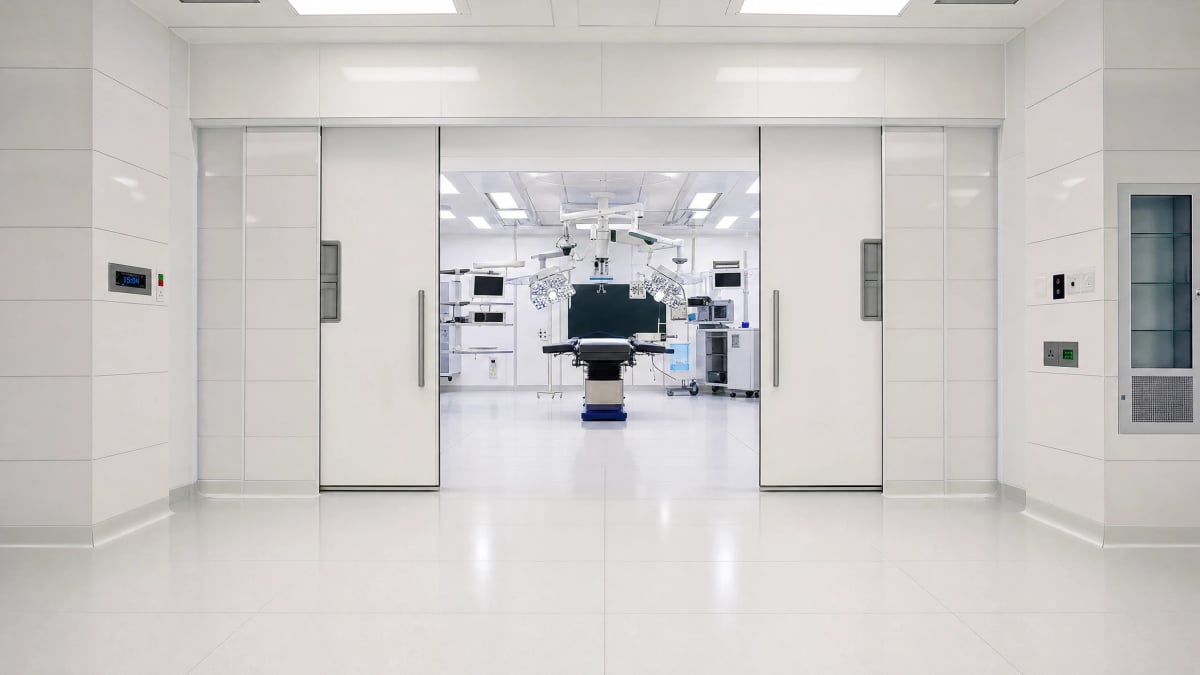
Pharmaceutical manufacturing, healthcare procedure-room adjacency, and specialist diagnostic environments require cleanroom-grade tile specification with documented compliance.
Notre approche
Tilers Ghana installs ISO 14644 cleanroom-adjacent tile systems with anti-microbial grout, controlled expansion-joint protocols, and full ASTM F2170 substrate moisture verification.
Tilers Ghana installs ISO 14644 cleanroom-adjacent tile systems with anti-microbial grout, controlled expansion-joint protocols, and full ASTM F2170 substrate moisture verification.
The Challenge
Clinical, pharmaceutical, and laboratory environments impose a level of tile specification that exceeds virtually every other construction sector. Floors and walls in procedure rooms, dispensary corridors, sterile preparation zones, and diagnostic suites must resist microbial colonisation, tolerate aggressive chemical cleaning agents, and maintain dimensional integrity under repeated thermal cycling — all while meeting regulatory standards that leave no margin for remediation after occupation. A hairline grout failure in a pharmaceutical cleanroom is not a maintenance item; it is a compliance event.
In Ghana’s expanding healthcare and life-sciences infrastructure, the gap between standard commercial tile installation and genuinely cleanroom-adjacent work is frequently underestimated. Contractors specify the tile correctly and then install it with conventional grout, inadequate substrate moisture verification, and expansion joints placed by habit rather than engineering. The result is premature grout deterioration, moisture ingress beneath the tile plane, and surface irregularities that compromise both infection-control protocols and regulatory inspection outcomes.
The Tilers Ghana Solution
Tilers Ghana has delivered cleanroom-adjacent tile systems across clinical, pharmaceutical, and laboratory facilities for nearly five decades. Our methodology begins before a single tile is set: every substrate undergoes ASTM F2170 in-situ relative humidity testing to verify moisture equilibrium, because no anti-microbial grout system performs as specified over a substrate that continues to off-gas vapour. This is not optional pre-work — it is the foundational discipline that determines whether the finished installation holds its specification over years of aggressive use.
Where the substrate clears verification, our installation teams work to a controlled expansion-joint protocol engineered for the specific thermal and chemical load of the space. Joint placement, width, and sealant selection are documented and handed over as part of the project record. Anti-microbial grout is installed at full-depth, with consistent joint width maintained by calibrated spacers — never by eye. The result is a surface that presents no microbial harbourage geometry and withstands hospital-grade disinfectant cycles without chromatic shift or structural degradation.
Material + System Specification
- Tile body: Vitrified porcelain or homogeneous vinyl-backed ceramic, minimum R10 slip resistance for wet clinical zones, confirmed by pendulum test certificate
- Grout system: Silver-ion or triclosan-compound anti-microbial grout, ASTM C1329-compliant, colour-stable under sodium hypochlorite and quaternary ammonium cleaning regimes
- Substrate verification: ASTM F2170 in-situ RH probes at a minimum frequency of one probe per 93 m², with written moisture report issued prior to adhesive application
- Adhesive: S1 or S2 flexible cementitious adhesive (ISO 13007-1), chemical-resistant formulation for pharmaceutical and laboratory subclasses
- Expansion joints: Engineered to BS 5385 / TCNA EJ171 protocol with EPDM or silicone sealant rated for continuous chemical exposure
- Cove base detail: Integrated sanitary cove at all wall-floor junctions, eliminating the 90-degree angle that traps biofilm
Typical Project Profile
A standard cleanroom-adjacent tile commission engages Tilers Ghana across sterile corridors, procedure rooms, dispensary floors, laboratory wet zones, and ancillary change facilities — typically 400 m² to 2,800 m² of combined floor and wall surface. Programme duration ranges from three to ten weeks depending on phasing constraints imposed by active clinical operations. Sectors served include private diagnostic clinics, pharmaceutical manufacturing facilities, public hospital wing refurbishments, dental surgery suites, and veterinary procedure rooms operating to institutional hygiene standards.
Outcomes
- Surfaces that meet ISO 14644 cleanroom-adjacent hygiene geometry — zero harbourage angles, full-depth sealed joints
- ASTM F2170 substrate moisture records held on file, available for regulatory inspection or facilities audit at any point post-completion
- Anti-microbial grout performance sustained across a minimum five-year disinfection cycle without re-grouting intervention
- Dimensional stability under repeated thermal cycling, confirmed by controlled expansion-joint engineering rather than assumed
- A complete material and methodology handover pack — tile certificates, grout data sheets, joint sealant specifications, and photographic installation record — delivered at practical completion